
Structural synthesis: preventing regression toward previous configurations
Closure and stabilization mechanisms to ensure that your new personal architecture maintains coherence under external pressure.
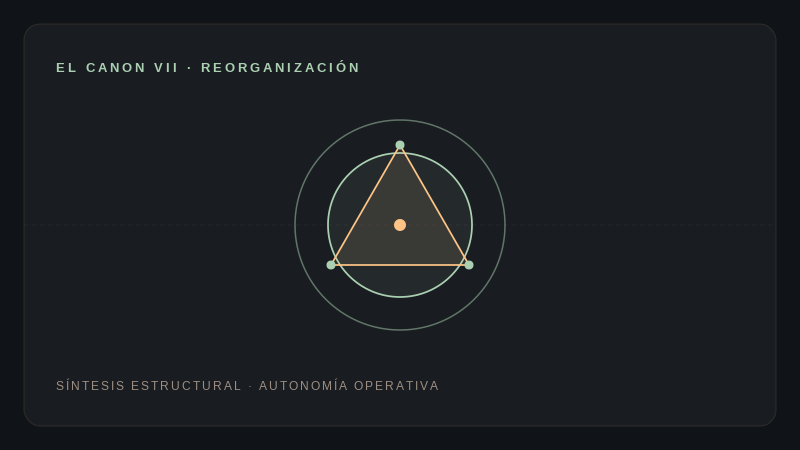
Structural Criterion · OneGyo“No reorganization is complete until the return pathways toward old compensatory habits have been deliberately closed.”
The Canon VII · Structural Synthesis
Every reconfiguration passes through a consolidation period in which traces of the former order coexist with the new operational structure. Structural synthesis complements the shift from forced correction to stable reorganization and ensures definitive closure of that transition.
1. Eliminating redundant structures
To prevent regression, you must dismantle residual environments, commitments, or routines that continued feeding the prior configuration identified during Structural Diagnosis.
“Regression happens when you upgrade your internal criteria but leave intact the external infrastructure built for your former configuration.”
The Canon VII · Structural Synthesis Closure
2. Autonomous maintenance protocols
Establish low-cost periodic technical reviews to ensure your reorganized architecture preserves long-term operational precision.
Anti-Regression Structural Shielding Protocol
Net_Stability(E) = New_Structure(S₁) − Residual_Links(R₀) DETECT_RESIDUALS(R₀) Identify contexts, routines, or agreements that still trigger prior-state responses.
REMOVE_REGRESSION_BRIDGES() Deliberately shut down return channels to obsolete routines.
MONTHLY_CANON_AUDIT() Execute a 15-minute monthly technical review of key system indicators.
Personal Engineering Workbook · The Canon I–VII
Baseline structure mapping templates, friction matrices, and pattern replacement protocols in an executable format.
“You have diagnosed the symptom; now move to modification architecture.”
A diagnosis without technical intervention becomes passive observation. Use the tools from the next domain of The Canon I–VII to translate this structural reading into deliberate adjustments on your system.